(A Comprehensive Biological and Mechanical Framework)
Fracture healing is not merely a mechanical process of stabilizing bone fragments; it is a complex biological event requiring the interaction of multiple regenerative elements. The Diamond Concept of Fracture Healing, introduced by Giannoudis et al., provides a structured framework for understanding and optimizing these essential components of bone repair.
Understanding the Diamond Concept
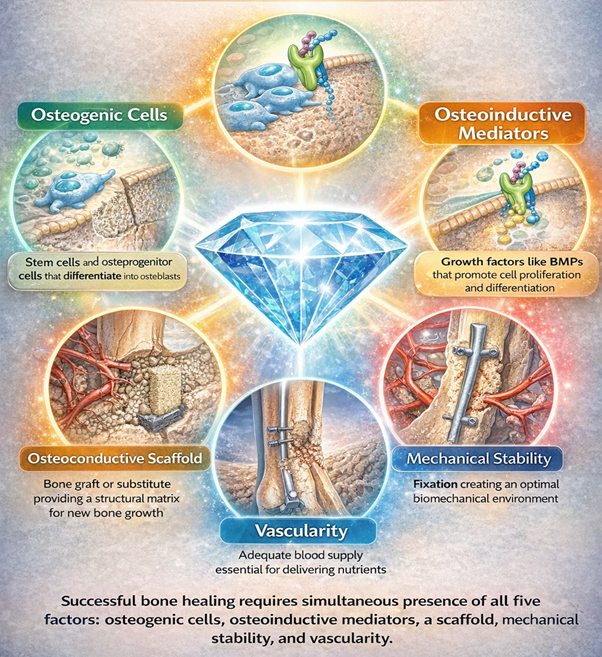
Delayed union and non-union remain significant challenges in orthopaedic practice, affecting approximately 5–10% of fractures. The Diamond Concept proposes that successful bone healing requires the presence of five essential factors:
- Osteogenic Cells – Mesenchymal stem cells and osteoprogenitor cells capable of differentiating into bone-forming osteoblasts.
- Osteo-inductive Mediators – Growth factors such as bone morphogenetic proteins (BMPs) that stimulate cellular proliferation and differentiation.
- Osteoconductive Scaffold – A structural framework (e.g., bone graft or substitute) that supports new bone formation.
- Mechanical Stability – Adequate fixation providing the optimal biomechanical environment for callus formation.
- Vascularity – An intact blood supply to deliver nutrients, oxygen, and cellular mediators essential for repair.
This integrative model highlights that fracture healing failure often results from deficiency in one or more of these elements.
Clinical Application
Management strategies guided by this framework may include revision fixation, autologous bone grafting, use of BMPs, biological enhancers, and optimization of systemic patient factors. In cases of delayed union or non-union, applying the diamond concept may involve:
- Revision fixation to improve stability
- Autologous bone grafting to provide osteogenic cells and scaffold
- Use of biological enhancers such as BMPs
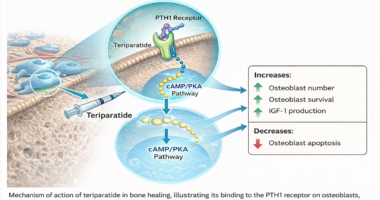
- Pharmacological adjuncts (e.g., anabolic agents like teriparatide)
- Addressing systemic factors such as smoking, diabetes, or malnutrition
The concept is particularly relevant in complex trauma, open fractures, and osteoporotic patients.
Expanding to the “Biological Era” of Orthopaedics
The Diamond Concept represents a paradigm shift from purely mechanical fixation toward biological optimization. As regenerative medicine advances, the integration of cellular therapies, growth factors, and pharmacological agents continues to evolve within this framework.
Conclusion
The Diamond Concept provides a comprehensive biological and mechanical roadmap for fracture healing. By ensuring the presence of osteogenic cells, growth factors, scaffold, stability, and vascularity, clinicians can significantly enhance union rates and improve patient outcomes.